

What is Enamel Hypoplasia?
Enamel hypoplasia is a condition where a person’s teeth don’t have enough enamel, which puts their teeth at risk for decay, erosion and other issues.3
Learn how it forms and what you can do to strengthen your enamel.
Key Takeaway
- Enamel hypoplasia occurs when enamel doesn’t fully form, leaving teeth thin, uneven, or discolored and more vulnerable to decay and erosion.
- Both genetics and environmental factors, like illness, malnutrition, trauma, or excessive fluoride exposure, can cause enamel hypoplasia.
- Treatment options like resin, veneers, or crowns can restore both function and appearance, but caring for enamel daily with fluoride toothpaste is essential, as enamel cannot repair itself.
What Is Enamel?
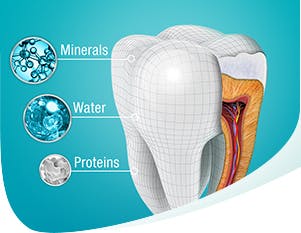
Your tooth enamel, which is the white outer surface that covers your teeth, is the hardest substance in your entire body.1 Enamel is 96 percent mineral, making it stronger than bones and resistant to damage.1
How Does Enamel Form?
Tooth enamel develops in two main steps. First, during the secretory stage, special cells called ameloblasts lay down a soft, protein-rich layer that shapes the enamel. Then, during the maturation stage, these cells switch roles to pump in minerals and regulate acidity, allowing the enamel crystals to grow larger and harder. By the end, enamel becomes almost entirely mineral, giving it the extreme strength needed to protect teeth for life.4
Although enamel plays an important role in ensuring that your teeth are strong, people with enamel hypoplasia may not have the same level of protection.
What Is Enamel Hypoplasia?
Enamel hypoplasia is a defect that can occur when there’s a disruption during enamel formation. This means that you may not have enough enamel to protect your teeth – it may be very thin or missing in some places.3
Symptoms of Enamel Hypoplasia
Enamel hypoplasia may appear as scars on the teeth such as3:
- Pitting or grooves on the surface of the teeth
- Brown or yellow discoloration
- Teeth appear opaque or chalky
- White spots on the surface of the teeth
- Enamel surfaces are irregularly shaped
Although enamel hypoplasia can happen in any permanent tooth, the teeth that are most likely to be affected are the permanent first molars, canines, and incisors with specific areas of defect.2,3
Is Enamel Hypoplasia Common?
Enamel defects like enamel hypoplasia are common.4 In fact, an estimated range of 20 to 80 percent of people in the world have an enamel defect.4
What Causes Enamel Hypoplasia?
Enamel defects like enamel hypoplasia can be caused by both hereditary and environmental factors.3 Hereditary enamel hypoplasia, or amelogenesis imperfecta, is passed down through families and can affect all of the enamel on your teeth.3
Environmental Causes of Enamel Hypoplasia
Environmental factors of enamel hypoplasia include:2,3,5
- Certain illnesses like chicken pox and measles
- Malnutrition
- Premature birth
- Trauma and infection of a tooth
- Vitamin and mineral deficiencies
- Exposure to tetracycline and lead
Dental Fluorosis and Hypoplasia
Dental fluorosis, or the condition that occurs when you ingest too much fluoride, is another likely cause of enamel hypoplasia.2 Although fluoride is a mineral that is beneficial for strengthening the enamel, fluoride ingestion may cause enamel hypoplasia as well.3
Is There a Treatment for Enamel Hypoplasia?
Enamel hypoplasia can be treated with a tooth colored composite resin, veneers, or a crown.6 Resin treatments work to improve the appearance of teeth that are affected by enamel hypoplasia and help improve the function of the teeth.6 The process of applying resin is simple, but should only be done by a dental professional.6 Talk to your dentist to find out more about treatment options for your teeth.
Why Is Caring for Your Enamel Important?
Although Pronamel products don’t treat enamel hypoplasia, protecting your enamel is important because healthy enamel keeps teeth free from cavities and other oral health issues.
Although your enamel is strong, it can’t repair itself like the other tissues in our bodies.1 Once the enamel is damaged, your teeth can only be restored by a dentist.1 To help keep your enamel strong and healthy, brush twice a day for two minutes each time with a fluoridated toothpaste like Pronamel Clinical Enamel Strength Deep Clean toothpaste. This enamel care formulation provides 3x stronger enamel protection* and helps to protect teeth for life.^ It encourages fluoride to bind to and act on enamel and leaves a long-lasting clean feeling.
When it comes to treating enamel hypoplasia, your dental professional knows the best solution to help restore the appearance and functionality of your teeth. Find more tips on enamel care and healthy living with Pronamel.
*vs your mouth’s natural defenses
^with twice-daily brushing
Source Citations:
- 5 Reasons Your Smile Is Stronger Than You Think. American Dental Association. https://www.mouthhealthy.org/5-reasons-your-smile-is-stronger-than-you-think Accessed 9/3/2025.
- Amelogenesis Imperfecta: An Introduction. British Dental Journal. Accessed 9/13/22. https://www.nature.com/articles/sj.bdj.2012.314
- Enamel hypoplasia and its role in identification of individuals: A review of literature. National Library of Medicine. https://www.ncbi.nlm.nih.gov/pmc/articles/PMC4455163/ Accessed 6/30/2022.
- Dental Enamel Formation and Implications for Oral Health and Disease. National Library of Medicine. https://www.ncbi.nlm.nih.gov/pmc/articles/PMC6151498/ Accessed 7/6/2022.
- Enamel hypoplasia in the primary dentition: a review. National Library of Medicine. https://pubmed.ncbi.nlm.nih.gov/1783694/ Accessed 7/6/2022.
- Aesthetic approach for anterior teeth with enamel hypoplasia. National Library of Medicine. https://www.ncbi.nlm.nih.gov/pmc/articles/PMC3354799/ Accessed 7/6/2022.